|
|

Main Menu
Home
National
Security News
Ukraine Conflict
Books
Security Information
Homeland Security
Terrorism
Special Operations
Maps
Site Map
Ads
This website is an Amazon Associate
and earns money for qualifying purchases.
Book:
US National Security
https://amzn.to/3ROvaKJ
Tomahawk Land Attack Missile (TLAM)
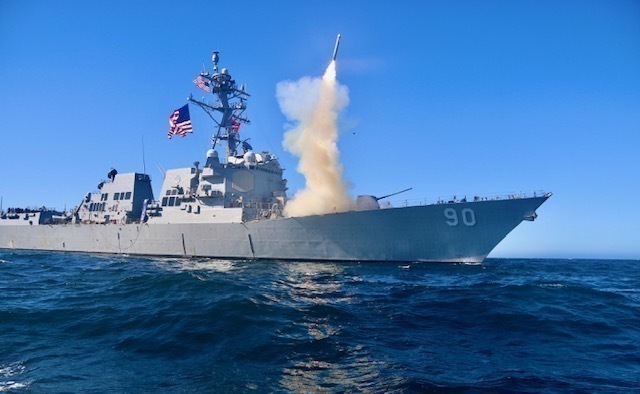
Photo: The guided-missile destroyer USS Chafee (DDG 90) launches a Block V Tomahawk. (U.S. Navy photo by Ensign Sean Ianno, 30 Nov 2020)
The U.S. Navy’s Tomahawk Land Attack Missile (TLAM) is a long-range, all-weather, subsonic cruise missile designed for precision strikes against high-value land targets. Developed during the Cold War to provide a survivable, stand-off strike capability, the Tomahawk allows naval forces to engage targets from hundreds of miles away without exposing pilots or ships to hostile defenses. It is launched from both surface ships and submarines, giving the United States flexible options for projecting power ashore while maintaining distance from contested coastlines.
The Tomahawk was originally developed by General Dynamics in the 1970s and later production and upgrades were managed by Raytheon Technologies (now operating as RTX Corporation). Early variants entered service in the 1980s, with the missile first seeing combat during Operation Desert Storm in 1991. Since then, the TLAM has been used in multiple conflicts, demonstrating high reliability and accuracy against fixed and, in later versions, relocatable targets.
Technically, the TLAM is a subsonic missile powered by a small turbofan engine and guided by a combination of inertial navigation, GPS, and terrain-contour matching systems. This layered guidance approach allows it to fly at low altitudes, following the contours of the terrain to reduce detection by radar. Modern variants, such as the Block IV Tactical Tomahawk, feature two-way satellite communications that enable in-flight retargeting and battle damage assessment. Depending on the variant, the missile carries either a conventional unitary warhead or, in earlier versions, submunitions designed for area targets.
There are limited supplies of the expensive missile. Only about 200 are manufactured in the United States each year. The defense industry has the capacity to manufacture up to 600 missiles each year. The total inventory of Tomahawks is not a figured that is released by the Pentagon, although the American Enterprise Institute pre-Iran War estimate was between 4,000 and 4,500 missiles were on hand. The Center for Strategic and International Studies (CSIS) estimated there were about 3,100 Tomahawks on hand in February 2026. The range of the missile exceeds 1,000 miles. Recent versions of the Tomahawk cost as much as $3.6 million a piece and required two years to build. The missiles are about 20 feet long and weigh about 3,500 pounds.
Strategically, the Tomahawk provides the U.S. Navy with a critical first-strike and deterrence capability. By launching from platforms such as Arleigh Burke–class destroyers and nuclear-powered submarines, commanders can rapidly respond to emerging threats without relying on forward air bases. Its precision reduces collateral damage compared to unguided munitions, making it a preferred option for limited, high-accuracy strikes. Over decades of service, the TLAM has evolved through continuous upgrades, ensuring it remains a central element of U.S. maritime strike doctrine.
References
Tomahawk Cruise Missile - U.S. Navy
https://www.navy.mil/Resources/Fact-Files/Display-FactFiles/Article/2169229/tomahawk-cruise-missile/
Tomahawk Missile - Wikipedia
https://en.wikipedia.org/wiki/Tomahawk_missile
News Articles
March 27, 2026, "U.S. uses hundreds of Tomahawk missiles on Iran, alarming some at Pentagon", The Washington Post. After 30 days of Operation Epic Fury, the U.S. has launched over 850 Tomahawks at targets in Iran.
Videos
USS Spruance (DDG 111) Fires a Tomahawk Land Attack Missile, courtesy
video, U.S. Central Command Public Affaris, DVIDS, March 2, 2026, 30
seconds.
https://www.dvidshub.net/video/997811/uss-spruance-ddg-111-fires-tomahawk-land-attack-missile
|
|
Books on National Security and Defense

https://bookshop.org/lists/national-security-and-defense
We are an affiliate of Bookshop.org and will earn a small commission if you click through and make a purchase.