|
|

Main Menu
Home
National
Security News
Ukraine Conflict
Books
Security Information
Homeland Security
Terrorism
Special Operations
Maps
Site Map
Ads
This website is an Amazon Associate
and earns money for qualifying purchases.
Book:
US National Security
https://amzn.to/3ROvaKJ
Unmanned Ground Vehicles
Home > Military > Drones > Unmanned Ground Vehicles (UGVs)
The Ukraine War has demonstrated the utility of Unmanned Ground Vehicles (UGVs) on the front lines. UGVs are now acting as sensors, carry munitions, carry weapons, conduct medevacs, and more. They can be used instead of humans. The UGVs can be wire-guided, receive radio signals, or operate from satellites.
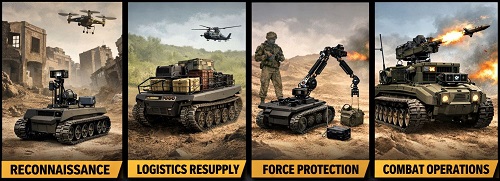
Unmanned Ground Systems (UGS) are rapidly evolving from specialized explosive ordnance disposal tools into versatile combat enablers capable of supporting reconnaissance, logistics, force protection, and direct fire missions across contested environments. Advances in robotics, artificial intelligence, sensor fusion, and autonomous navigation are enabling UGS to operate in complex terrain while reducing risk to personnel and sustaining operational tempo.
Recent conflicts, particularly in Ukraine, demonstrate how robotic ground platforms can support last-mile resupply, forward sensing, and precision targeting in environments heavily saturated by surveillance and long-range fires. Despite their advantages, UGS face constraints including communications vulnerability, limited endurance, mobility challenges, and evolving legal considerations regarding autonomy in lethal roles.
Continued experimentation, doctrinal adaptation, and integration with aerial and space-based ISR networks will determine the extent to which UGS reshape future land warfare. Properly employed, UGS will likely serve as force multipliers that expand operational reach while mitigating battlefield risk.
The use of UGV keeps soldiers away from the frontlines of the battlefield - saving lives. That results in more soldiers available for offensive operations and a slower rate of personnel attrition.
News Articles
April 15, 2026, "Aerial Drones Change How Wars are Fought - Unmanned Ground Vehicles Will Decide Who Wins Them", by James Chaney, Modern War Institute.
March 9, 2026, "Networked for War: Lessons From Ukraine's Ground Robots", by Jorge Rivero, Modern War Institute at West Point. In the past few years, Ukraine has gone from test ground drones to fielding thousands of unmanned ground vehicles on the front line.
|
|
Books on National Security and Defense

https://bookshop.org/lists/national-security-and-defense
We are an affiliate of Bookshop.org and will earn a small commission if you click through and make a purchase.