|
|

Main Menu
Home
National
Security News
Ukraine Conflict
Books
Security Information
Homeland Security
Terrorism
Special Operations
Maps
Site Map
Ads
This website is an Amazon Associate
and earns money for qualifying purchases.
Book:
US National Security
https://amzn.to/3ROvaKJ
F-15E Strike Eagle
Home > Weapons > Aircraft
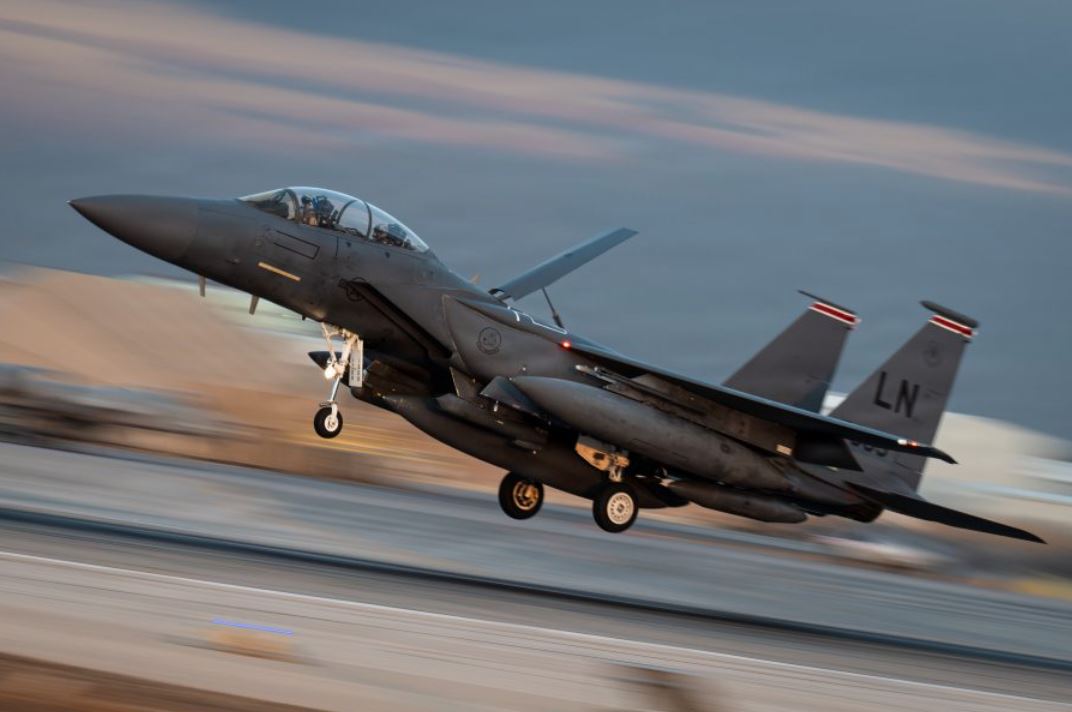
Photo: A U.S. Air Force F-15E Strike Eagle assigned to 494th Expeditionary Fighter Squadron lands at a base in the Middle East, January 18, 2026. Courtesy photo CENTCOM, Facebook.
The F-15E Strike Eagle is a twin-engine, two-seat, all-weather multirole fighter developed for the United States Air Force to perform deep interdiction and precision strike missions while retaining strong air-to-air combat capability. It is a derivative of the earlier F-15 air superiority fighter, redesigned to carry heavier payloads over long distances and to operate at low altitude in hostile environments. The aircraft combines speed, range, and payload capacity with advanced avionics, enabling it to conduct day or night operations in virtually any weather conditions.
The Strike Eagle was developed by McDonnell Douglas (now part of Boeing) and first entered service in 1989. It was selected after the Enhanced Tactical Fighter competition to replace the aging F-111 fleet. The aircraft retains the powerful twin-engine configuration of the original F-15, powered by Pratt & Whitney F100 turbofan engines, but incorporates strengthened airframe structures, conformal fuel tanks for extended range, and a second crew member—a Weapon Systems Officer—to manage complex strike systems and targeting equipment.
Equipped with advanced radar and targeting systems, including the AN/APG-70 and later AN/APG-82 Active Electronically Scanned Array (AESA) radar, the F-15E can track multiple targets and deliver precision-guided munitions with high accuracy. It is capable of carrying a wide range of weapons, including air-to-air missiles, laser-guided bombs, GPS-guided Joint Direct Attack Munitions (JDAMs), and stand-off weapons. Despite its strike-focused mission, the aircraft maintains formidable air combat performance, allowing it to defend itself and escort other aircraft when required.
The F-15E has seen extensive combat service in operations such as Operation Desert Storm, Operation Enduring Freedom, Operation Iraqi Freedom, and Operation Epic Fury. Throughout these conflicts, it demonstrated its ability to conduct long-range strike missions, close air support, and strategic interdiction with high reliability. Continuous upgrades to avionics, weapons integration, and survivability systems have kept the Strike Eagle relevant into the 21st century, and it remains a cornerstone of U.S. and allied tactical air power.
References
F-15E Strike Eagle Fact Sheet, U.S. Air Force
https://www.af.mil/About-Us/Fact-Sheets/Display/Article/104499/f-15e-strike-eagle/
|
|
Books on National Security and Defense

https://bookshop.org/lists/national-security-and-defense
We are an affiliate of Bookshop.org and will earn a small commission if you click through and make a purchase.