|
|

Main Menu
Home
National
Security News
Ukraine Conflict
Books
Security Information
Homeland Security
Terrorism
Special Operations
Maps
Site Map
Ads
This website is an Amazon Associate
and earns money for qualifying purchases.
Book:
US National Security
https://amzn.to/3ROvaKJ
Millennium Challenge 2002
In 2002, U.S. Joint Forces Command (JFCOM), now-defunct, conducted an exercise that ws the most ambitious and costly simulation ever. It pitted the U.S. against a fictional adversary in the Middle East (can you say Iran?) using technology assumed to be available five years in the future (2007).
The war game was staffed by 15,000 personnel and cost $250 million dollars. It took place after the invasion of Afghanistan that took place in the fall of 2001 but before the invasion of Iraq in the spring of 2003. The exercise was designed to test operational concepts that were under development.
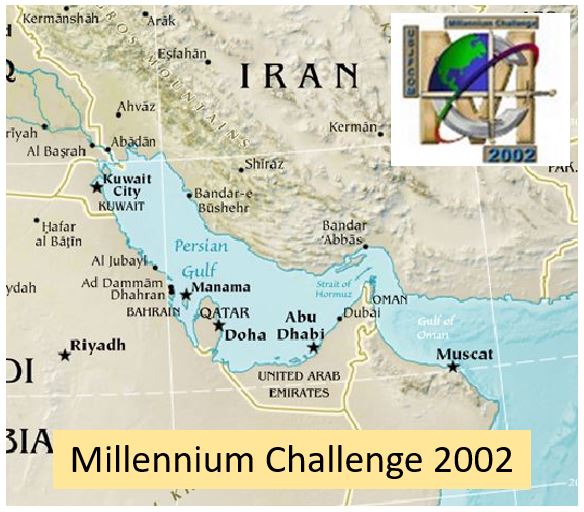
The scenairo called for a forced-entry of U.S. forces - using the 82nd Airborne Division and a Marine division supported by air and naval forces. The U.S. was the "Blue Team" while a "Red Team" was the opposing force (OPFOR). The Blue Team was supposed to win but lost - after the fictional country destroyed the U.S. fleet in the Persian Gulf.
The Red Team utilized low-tech and unconventional methods to sink the American fleet. Missiles from land-base launch sites, civilian boats and commercial ships, and radio-silent, low-flying planes were sent against the naval force. In addition, explosive-laden suicide speedboats added to the attack resulting in the U.S. fleet defences being overwhelmed.
When a U.S. Navy carrier battle group entered the Persian Gulf it encountered a surprise attack from its adversary. Nineteen U.S. ships, including the aircraft carrier, were destroyed and sunk within 10 minutes.
The exercise was halted and the scenario reset - with "new rules" in place that would ensure the U.S. was able to complete the forced-entry into Iran with ground forces.
An official 752-page final report on MC-02 was classified as "For Official Use Only"'; later ruled releasable to the public. It called the game a major milestone and downplayed the role of the opposing forces in sinking the carrier battle group. Many participants in the exercise were considering MC-02 a rehearsal for the invasion of Iraq that most felt would soon happen.

References
March 12, 2026, "A Marine Corps general led a fictional Iran against the US military - and won", by Blake Stilwell, We Are the Mighty.
September 21, 2025, "The Millennium Challenge of 2002", Quintus Curtius - Fortress of the Mind.
October 30, 2024, "Revisiting Millennium Challenge", PAXsims.
October 20, 2024, "How the U.S. military lost a $250 million war game in minutes", The Washington Post. Posted on GWU.edu archives. (PDF, 5 pgs)
January 3, 2020, "The U.S. Lost a (Fictional) War with Iran 18 Years Ago", Popular Mechanics.
November 6, 2019, "The lost lesson of Millennium Challenge 2002", Task & Purpose.
January 18, 2018, "Millennium Challenge 2002", Naval Gazing.
November 5, 2015, "Millennium Challenge: The Real Story of a Corrupted Military Exercise and its Legacy", by Micah Zenko, War on the Rocks.
December 17, 2003, "The Immutable Nature of War", Nova PBS.org. General Paul Van Riper, the OPFOR commander for MC-02 is interviewed on why technology can be defeated using unconventional methods.
Millennium Challenge 2002, WikipediA
https://en.wikipedia.org/wiki/Millennium_Challenge_2002
|
|
Books on National Security and Defense
https://bookshop.org/lists/national-security-and-defense
We are an affiliate of Bookshop.org and will earn a small commission if you click through and make a purchase.